PhD Spotlight: Finn Klebe

Finn Klebe is a PhD student whose work focuses on a better understanding of different forms of collective action, the intersection of violent and nonviolent tactics, and varying inter-group relations. For his project, “Accomplice or Spoiler? Assessing the Impact of Violent Wings on Collective Action”, he examines the emergence of violent wings within contentious movements, their varying functions over time, as well as different levels of integration within complex movement networks. He is supervised by C&C members Kristin Bakke and Nils Metternich

Theoretically, he argues that violent wings often emerge organically within movements, supported by more radical frames and tactics. However, their function pertaining to government concessions and the level of violence depends on the level of integration of such subgroups within movement networks. Precisely, the level of integration is driven by the demands of a movement constituency, the level of mobilisation, and the (lack of) access to institutions for the nonviolent parts of the movement over time.

He pursues a mixed-methods research design, employing both in-depth case studies as well as quantitative network analysis. Qualitatively, his collection of micro-level data (e.g. participant interviews, archival data) tries to shed new light on decision-making processes of activists when choosing contentious strategies and interacting with different subgroups. Making use of this micro-level data, he seeks to further leverage the different relations and levels of integration between movement members by utilising quantitative network analysis.

Prior to his current project, he worked on an article, which introduced a theoretical framework of cross-national diffusion of collective action. Additionally, he has also contributed to an analysis of varying responses to the Covid-19 pandemic, as well as worked on a project in collaboration with Democracy Reporting International (DRI) that monitored the social media landscape and potential threats to the integrity of the German federal elections 2021 online.

PhD Spotlight: Sam Erkiletian

Sam Erkiletian is PhD Candidate researching the internal dynamics of armed groups—specifically the changing identities of combatants during and after conflict. He is interested in how the military socialization process and subgroup dynamics of armed groups affect the behavior and identity of combatants. He employs comparative case studies and data from conflict archives in his research. He is supervised by C&C members Kristin Bakke, Nils Metternich, and Zeynep Bulutgil

His research project, “Socialization and Resocialization: The Changing Identities of Combatants”, examines how former combatants reshape their identity in postwar settings. Sam theoretically argues that one of the main drivers of identity formation and reformation are subgroups, the social units within armed organizations that form its informal structure and environment. He contends that subgroups guide combatants through the socialization process and that they can reinforce the intended norms of the wider organization or undermine them. 

To test his theories, Sam leverages archival data from cases of state-sponsored re-education programs for prisoners of war (POWs). Two of the cases he examines—the British re-education program for German POWs (1944-1948) and the US re-education program for Chinese and Korean POWs (1950-1953)—provide unique data for tracking the changing identities of combatants.  

The National Archives houses reports and administrative data on the British re-education program for German POWs

Sam has a co-authored chapter with Zeynep Bulutgil, “Civil Society, Fifth-Column Perceptions, and Wartime Deportations: Japanese and German Americans”, which is a part of the forthcoming edited volume Enemies Within published by Oxford University Press. He is also working with Nils Metternich and Janina Beiser-McGrath on an archival data project that analyzes the networks of delegates that attended the various Pan-African conferences from 1945 to 1963 and how they influenced colonial and post-colonial states.   

PhD Spotlight: Sigrid Weber

Sigrid Weber is a PhD Candidate focusing on internal displacement, local conflict dynamics, and territorial control in civil wars.

Her PhD research project, “Controlling a Moving World: Territorial Control, Displacement and the Spread of Civilian Targeting in Iraq”, analyzes how armed actors in civil wars respond to moving population groups within conflict zones and how this affects patterns of violence against civilians. She focuses particularly on violent dynamics during the Iraqi civil war against the Islamic State. Her research is supervised by C&C members Alexandra Hartman and Nils Metternich.

Sigrid theoretically argues that displacement alters local balances of control between territorial rulers and challengers and that rulers have incentives to govern violently if displaced persons from opposing loyalty groups move into their territories. Meanwhile, challengers spoil local governance by inflicting harm on civilians if incoming supporters of a local ruler reinforce the governor’s control.

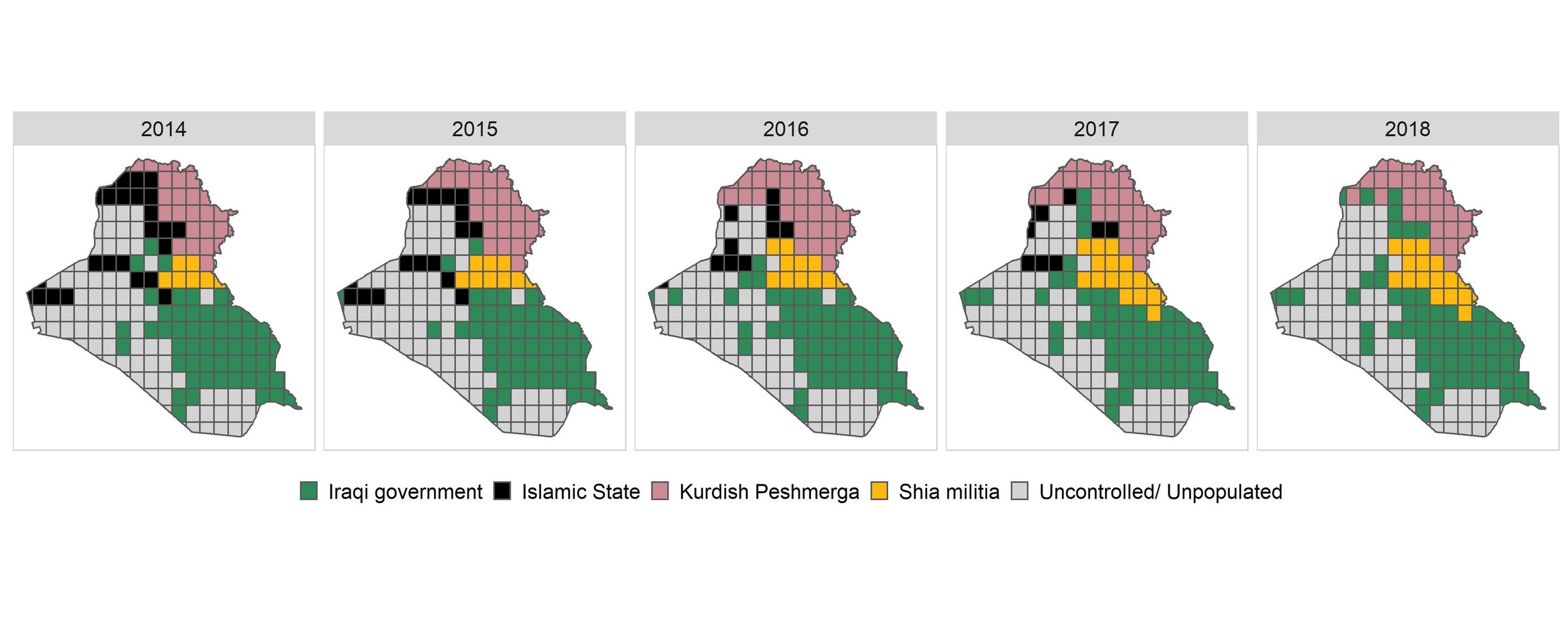
To test these dynamics, she uses a combination of manual coding and machine learning to create a novel monthly dataset of territorial control, one-sided violence against moving populations and displacement patterns dis-aggregated by ethno-religious groups in the Iraqi civil war against the Islamic State (2014-2017).

Territorial Control in Iraq per year from Sigrid’s PhD research project using hand-coded and classified data

Sigrid has two co-authored publications, “Under the Roof of Rebels: Civilian Targeting after Territorial Takeover in Sierra Leone” in International Studies Quarterly and “Violence, Displacement, and Support for Internally Displaced Persons: Evidence from Syria” in the Journal of Conflict Resolution. She is also involved in two ongoing data collection efforts— one on property rights and return decisions of Yazidis in Iraq and the other on social cohesion amongst youth leaders in Myanmar.

Beyond her dissertation research, Sigrid examines when and how civilians make their choices to flee, how we can predict the resulting patterns of forced migration, and what impact these population movements have on conflict dynamics and post-conflict situations. She is also interested in refugee policies, statelessness, and civilian resilience in fragile settings. In addition to her academic research, she is also a consultant for the World Bank-UNHCR Joint Data Center on Forced Displacement, supporting their data collections and their work with the Expert Group on Refugee and IDP statistics.

Stephanie Schwartz Joins C&C as a Visiting Scholar

Stephanie Schwartz, Assistant Professor of International Relations at the University of Southern California, is serving as a visiting scholar with C&C this term. As a visiting scholar, Schwartz will be working on her book manuscript, Homeward Bound: Refugee Return and Local Conflict After Civil War. Homeward Bound examines how return migration after civil wars affects local conflict dynamics in refugees’ country of origin, and in turn shapes future patterns of cross-border displacement. Schwartz is also working on several projects related to the centrality of refugee return in global asylum governance. Schwartz is presenting at C&C on November 17th, 2021.